What is subject workload balancing for uni students?

TL;DR:
- Subject workload balancing involves continuously planning and adjusting your study tasks across all subjects to prevent overload. It improves time management by prioritizing assessments based on deadlines, weightings, and mental effort, ensuring steady progress throughout the semester. Using tools like a master calendar and assignment tracker helps you stay organized and adapt quickly to new deadlines or changes.
Subject workload balancing is the deliberate, ongoing process of spreading your academic tasks across all your subjects so no single unit swamps you while others get ignored. It covers assignments, revision, readings, and deadlines, and it requires continuous adjustment as your semester unfolds. Most students know the feeling of hitting week 8 with three essays due in four days. That is not bad luck. It is what happens without active subject workload management. Tools like Culleva, internal calendars, and structured weekly schedules are the practical backbone of getting this right.
What is subject workload balancing and why does it matter?
Subject workload balancing is defined as the distribution of study tasks across multiple subjects to avoid overloading any single unit while matching your deadlines to your actual capacity. The key word is “continuous.” You are not setting a plan once in O-week and forgetting it. You are reviewing and adjusting it every week as new assessment details land on Canvas or Moodle.

The reason it matters is simple. When you carry four units in a trimester, each with its own essays, quizzes, and group work, the cognitive load compounds fast. PSYC101 might have a 2,000-word report due the same week ECON102 has a mid-semester test. Without a plan that accounts for both, you end up doing one badly or both at the last minute. Effective workload management gives you visibility across all subjects so you can see clashes before they become crises.
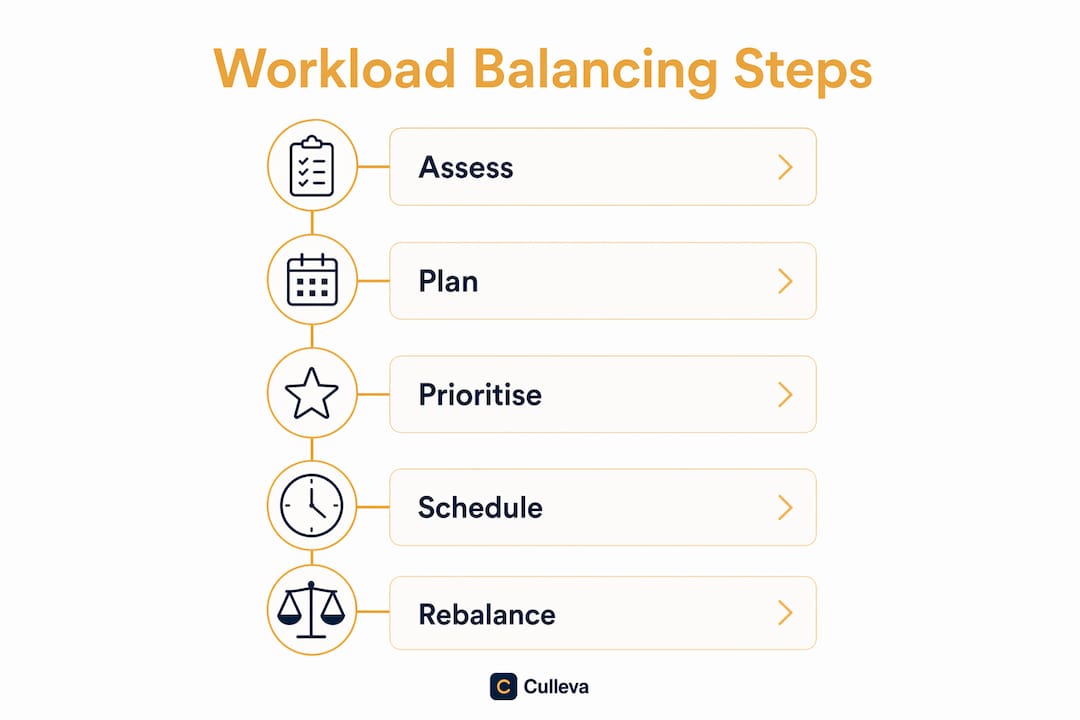
The formal term used in productivity and project management circles is “workload management.” Subject workload balancing is the student-specific version of that concept. Both refer to the same core practice: plan, distribute, track, and rebalance.
How does subject workload balancing actually work in practice?
The mechanics are straightforward once you break them down. Deakin University’s study support guidance recommends a three-layer approach that works well for any Australian or New Zealand student.
- Trimester or semester overview. At the start of each study period, map every known deadline across all your units onto a single calendar. You are looking for clusters where multiple assessments land in the same week.
- Weekly schedule. Each week, set specific study blocks for each subject based on what is due soonest and what carries the most weight in your final grade. A 40% essay deserves more hours than a 5% quiz.
- Daily prioritisation. Each day, pick your top two or three tasks. The Ivy Lee Method suggests listing your most important tasks by priority and working through them one at a time, finishing each before moving to the next.
The continuous rebalancing part is what most students skip. New assessments get posted mid-semester. Group work timelines shift. Tute participation marks appear out of nowhere. Your plan needs a weekly review, not a one-off setup.
Pro Tip: Use time-boxed study blocks of 25 or 50 minutes per subject, similar to the Pomodoro method. Switching subjects between blocks keeps your focus sharp and prevents one unit from eating your whole day.
What common misconceptions about workload balancing should you avoid?
The biggest misconception is that balancing your workload means spending equal time on every subject every day. It does not. Workload management is based on capacity and priorities, not equal time splits. Some weeks, LAWS1001 will need 80% of your study hours. Other weeks, it needs almost none.
A few other myths worth clearing up:
- Multitasking across subjects works. It does not. Switching between an essay draft and a statistics problem set in the same sitting costs you more time than it saves. Focus on one subject stream at a time.
- Balanced means equal cognitive effort. Writing a 3,000-word essay and completing a set of maths problems might both take two hours, but they draw on completely different mental energy. Balancing cognitive load types across your week matters as much as balancing hours.
- A plan made in week 1 stays valid all semester. Assessments change. Extensions get granted. New tasks appear. Your plan is a living document, not a contract.
Pro Tip: At the start of each week, check your Canvas or Moodle notifications before you open your planner. Update your schedule with any new deadlines before you commit to the week’s study blocks.
What practical techniques can you use to balance your subject workload?
These are the workload distribution methods that actually hold up across a full semester.
- Build a master deadline calendar. A single calendar tracking all subjects’ deadlines in one place lets you spot deadline clusters before they hit. Colour-code by unit so ACCT1101 and MKTG2002 are visually distinct.
- Create micro-deadlines. A 3,000-word essay due in week 10 needs internal checkpoints: outline by week 7, first draft by week 8, edits by week 9. Breaking tasks into stages prevents deadline stacking and last-minute panic.
- Prioritise by weighting, not just urgency. A task due tomorrow that is worth 5% should not automatically beat a task due next week worth 40%. Factor in assessment weighting when you schedule your study blocks.
- Schedule by cognitive load type. Put your hardest thinking tasks, like essay writing or problem sets, in your peak focus hours. Save lower-effort tasks, like formatting references in APA or Harvard style, for when your energy dips.
- Review and adjust weekly. Set a 15-minute planning session every Sunday. Check what is coming up, what slipped, and where you need to shift hours between subjects.
Here is how different workload distribution methods compare:
| Technique | Best for | Key benefit |
|---|---|---|
| Master deadline calendar | Semester-wide visibility | Spots deadline clusters early |
| Micro-deadlines | Large assessments | Prevents last-minute overload |
| Priority-by-weighting | Weekly scheduling | Focuses effort where marks are |
| Cognitive load scheduling | Daily planning | Matches task type to energy level |
| Weekly review | Continuous rebalancing | Keeps your plan current |
Pro Tip: Use assignment tracking tools to log every deadline as soon as it appears on your unit outline. Waiting until week 5 to enter week 9 deadlines is how clashes sneak up on you.
How do you handle new assessments or deadline changes mid-semester?
Rebalancing works best when you act immediately after a new deadline lands, not at your next scheduled planning session. The moment your lecturer posts a new assessment on Moodle, open your calendar and slot in the due date plus your micro-deadlines.
A few practical steps for mid-semester adjustments:
- Identify what gets deprioritised. Adding a new task means something else gets less time. Decide consciously which subject gets fewer hours that week rather than letting it happen by accident.
- Move preparatory work earlier. If a new assignment lands in week 7 and you have a major essay due in week 8, shift your week 8 essay prep into week 6. Deadline stacking is preventable if you act fast.
- Rebalance cognitive load types. If you suddenly have two writing-heavy tasks in the same week, see if any problem-solving or revision tasks can shift to give your brain variety.
- Communicate with your group. If the new task involves group work, update your shared schedule immediately. Culleva’s group-work hub keeps shared deadlines and files in one place, so everyone sees changes as they happen.
The students who handle mid-semester chaos best are the ones who treat their plan as a feedback loop, not a fixed timetable. Every new piece of information is a prompt to adjust, not a reason to stress.
Key takeaways
Subject workload balancing requires continuous planning, prioritisation, and rebalancing across all your units, not a one-off schedule set at the start of semester.
| Point | Details |
|---|---|
| Core definition | Workload balancing distributes tasks across subjects to match deadlines to your actual capacity. |
| Not equal time splits | Prioritise by assessment weighting and cognitive load, not by giving each subject the same hours. |
| Micro-deadlines prevent overload | Break large assessments into staged checkpoints to avoid last-minute deadline stacking. |
| Rebalance immediately | Update your plan the moment a new deadline or assessment detail appears on Canvas or Moodle. |
| Tools make it stick | A master calendar plus an assignment tracker keeps all subjects visible and your plan current. |
Culleva keeps your workload organised across every subject
Staying on top of four units’ worth of deadlines, readings, and assessments is a lot to hold in your head. Culleva is built for exactly this. It tracks every assignment and deadline across all your subjects in one place, so you can see your full semester at a glance and spot clashes before they become problems.
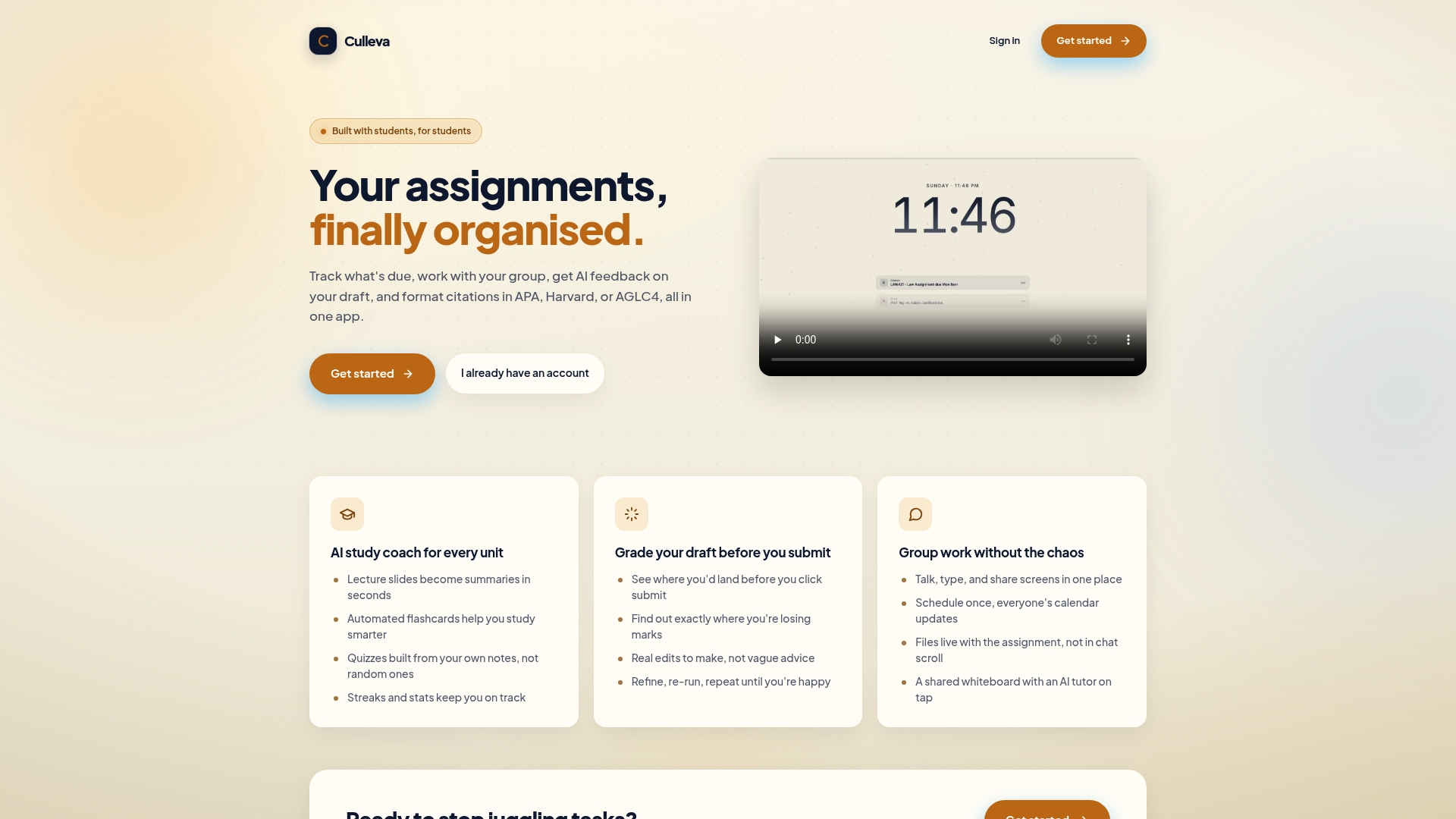
Culleva also helps you rebalance on the fly. When a new assessment lands on Moodle, you can log it instantly and adjust your study schedule without rebuilding your whole plan from scratch. The AI study coach turns your lecture slides into summaries and auto-generates flashcards, so your revision time goes further too. If you are juggling group work alongside solo assessments, the group-work hub keeps shared deadlines, files, and chat in one place. Try Culleva and get your semester finally organised.
FAQ
What is subject workload balancing?
Subject workload balancing is the process of distributing your study tasks across all your university subjects to avoid overloading any single unit. It involves planning, prioritising by deadlines and assessment weighting, and continuously adjusting your schedule throughout the semester.
Is workload balancing the same as splitting study time equally?
No. Effective workload management is based on priorities and capacity, not equal time splits. Some subjects will need more hours in a given week depending on upcoming deadlines and assessment weightings.
How often should I rebalance my study plan?
Review and adjust your plan weekly, and update it immediately whenever a new deadline or assessment detail appears. Rebalancing works best when it happens right after new information arrives, not days later.
What is a micro-deadline and why does it help?
A micro-deadline is a self-set checkpoint within a larger assessment, such as completing your essay outline by week 7 before the final submission in week 10. Breaking tasks into stages prevents deadline stacking and keeps your workload steady across the semester.
Can an app help with subject workload management?
Yes. Planning tools and apps that track deadlines across all subjects improve workload visibility and make it easier to adjust your schedule as new assessments appear. Culleva combines deadline tracking, study tools, and group-work scheduling in one place for Australian and New Zealand students.
Recommended
Stay on top of every assignment
Culleva brings your assignments, group work, calendar, and an AI study coach into one place. Free to start.