Stay on top of readings: a uni student's guide

TL;DR:
- Staying on top of readings involves prioritizing the right texts at the right time and actively engaging with them.
- Using tools like pre-reading goals, scheduled deep reading sessions, and weekly reviews helps build long-term retention and avoid burnout.
Staying on top of readings is defined as actively engaging with assigned texts, prioritising them by importance, and managing your study time so nothing piles up. It’s not about reading everything at full speed. It’s about reading the right things, at the right time, with enough focus to actually retain them. Active reading, systematic review, and spaced repetition improve long-term retention by 50–80% compared to passive reading. That gap is the difference between skimming a chapter the night before your tute and genuinely understanding it.
How to stay on top of readings: tools and mindset
The biggest mistake students make is chasing volume instead of quality. Reading 200 pages of loosely relevant material does less for your WAM than reading 60 pages with real focus and a clear goal.
Upstream curation is the first fix. That means deciding what enters your reading list before you sit down to read, not after. For a unit like PSYC101, that looks like scanning your Canvas module each Monday and flagging only the required readings plus one or two recommended ones that directly support your upcoming assessment. Everything else stays unread until you have spare capacity.
Setting a pre-reading goal takes 60 seconds and pays off for the whole session. Before you open a journal article or textbook chapter, write one question you want answered by the end. This keeps your attention anchored and stops you from drifting through paragraphs without absorbing anything.
Simple tracking also matters. You don’t need a complex system. A shared note or a basic checklist in Culleva’s assignment tracker works fine. The point is to see what’s done, what’s pending, and what’s due soon, all in one place.
- Curate before you read. Scan your unit outline and mark required readings as non-negotiable. Flag recommended readings only when they connect to an assignment.
- Set one question per reading. Write it at the top of your notes before you start.
- Track completion. Tick off readings as you finish them so you can see your actual progress across units.
Pro Tip: Link your reading list directly to your assignment deadlines. If an essay on cognitive bias is due in Week 8, your related readings should be done by Week 6 at the latest. Culleva’s assignment deadline management guide covers exactly how to build this buffer.
How do you prioritise and schedule readings effectively?
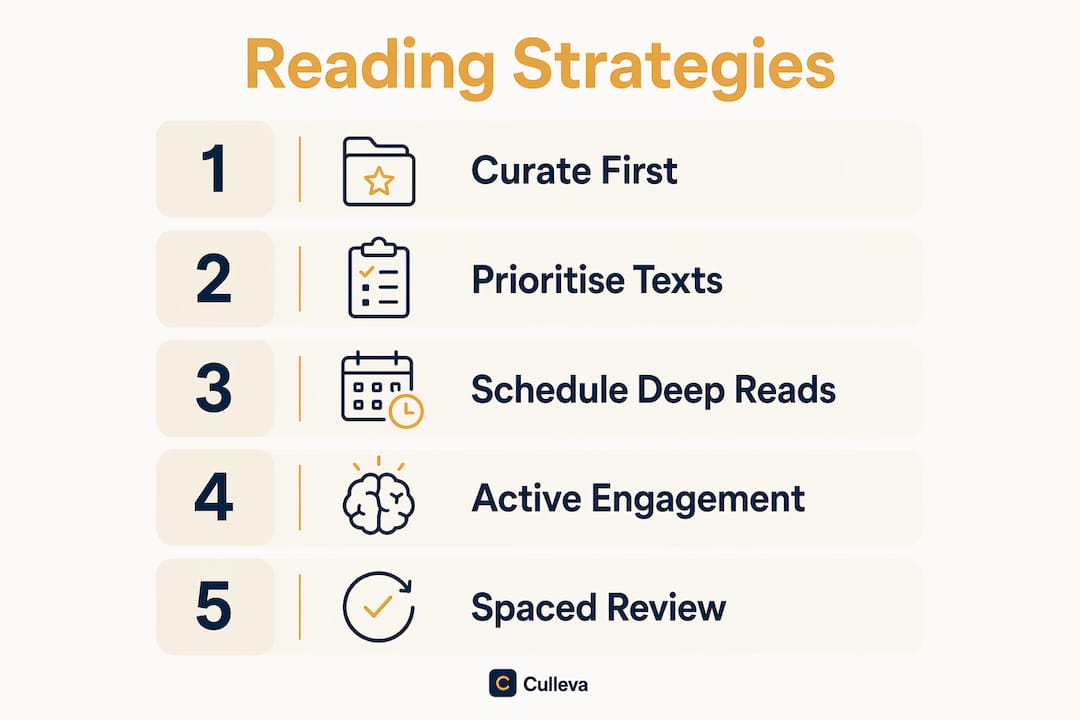
Prioritisation starts with a simple split: required versus recommended. Required readings are non-negotiable. Recommended readings are conditional. Do them when they directly support an assignment or when you’ve already cleared your required list for the week.
Once you know what to read, schedule it. Time blocking for reading increases productivity by 30% and reduces the cognitive cost of switching between tasks by 40%. That’s a meaningful gain from simply putting “reading” in your calendar like a lecture.
The 52/17 rhythm works better than shorter interval methods for sustained reading sessions. You read with full focus for 52 minutes, then rest for 17. This cycle aligns with your brain’s natural ultradian rhythms, which means you’re working with your biology instead of against it. Pomodoro’s 25-minute blocks feel more manageable but cut sessions short before deep comprehension kicks in.
- Split your reading list each week. Mark required readings in red, recommended in blue. Only move to blue once red is done.
- Block reading time in your calendar. Treat it like a lecture. A 9AM slot on Tuesday and Thursday for 52 minutes each covers most weekly reading loads.
- Put your phone in another room. Not on silent. Not face down. Another room. Distraction costs you more time than you think.
- Use the 52/17 rhythm. Set a timer for 52 minutes of focused reading, then take a proper 17-minute break before the next block.
Pro Tip: If you’re behind on readings for a unit like LAWS1010, don’t try to catch up in one sitting. Schedule two 52-minute blocks across two days. Spreading it out improves retention and stops you burning out before the session ends.
What active reading strategies improve retention?
Active reading is defined as engaging with a text by questioning it, connecting it to what you already know, and recording ideas in your own words. Passive reading, where you move your eyes across the page without doing any of that, loses you most of what you read. You lose 56% of new information within one hour and 67% within 24 hours without active engagement.

The Feynman technique is one of the most effective tools here. After finishing a section, close the text and explain the concept out loud as if you’re teaching it to someone who knows nothing about it. Where you stumble is exactly where your understanding has a gap. Go back and re-read only that part.
Reading in themed clusters deepens comprehension further. Instead of reading one article on memory formation for PSYC101 and then jumping to a contract law case for LAWS1010, group two or three texts on the same topic together in one session. The perspectives build on each other and your notes become richer.
Spaced repetition combined with self-quizzing boosts retention by up to 150% compared to a single read-through. Culleva’s AI study coach auto-generates flashcards and quizzes from your own notes, which makes this easy to build into your weekly routine without extra effort.
| Strategy | What it involves | Best for |
|---|---|---|
| Feynman technique | Explain the concept aloud after reading | Checking comprehension gaps |
| Spaced repetition | Review notes at increasing intervals | Long-term retention across units |
| Themed clustering | Group related texts in one session | Synthesising ideas for essays |
| Pre-reading questions | Write one question before each reading | Staying focused during the session |
How do you maintain reading progress and avoid burnout?
Momentum is the hardest part of managing your reading workload. You can have a great system in Week 2 and completely abandon it by Week 6. The fix is a short weekly review ritual.
A weekly 15–20 minute review of your reading notes turns scattered highlights into connected knowledge. It also shows you what you’ve actually covered versus what you thought you covered. Those are often different things.
- Every Sunday, spend 15 minutes reviewing your reading notes from the week. Don’t rewrite them. Just read through and add one connecting idea between readings where you can.
- Prune your reading list monthly. Drop any recommended readings that no longer connect to an active assignment. A leaner list is a more manageable one.
- Check your unit outlines for the coming week every Monday morning. Flag new required readings immediately so they don’t sneak up on you.
- Balance readings across units. If COMM2040 has a heavy reading week, pull back on optional readings for your other units. Workload balancing across units is a skill worth building early.
| Weekly habit | Time required | Outcome |
|---|---|---|
| Sunday note review | 15–20 minutes | Converts notes into lasting knowledge |
| Monday outline scan | 10 minutes | Flags new readings before they pile up |
| Monthly list prune | 15 minutes | Keeps reading list focused and realistic |
| Deadline-linked reading check | 5 minutes | Prevents last-minute cramming before assessments |
Tracking your reading alongside your assignments is the clearest way to see whether your workload is balanced. Culleva’s study progress tracking shows you exactly where your time is going across units, which makes it easy to spot when one subject is eating too much of your week.
Key takeaways
Staying on top of readings requires upstream curation, active engagement techniques, scheduled deep reading sessions, and a short weekly review ritual to build lasting retention.
| Point | Details |
|---|---|
| Curate before you read | Limit your reading list to required texts and directly relevant recommended ones each week. |
| Schedule dedicated reading blocks | Use 52-minute focused sessions to raise productivity and reduce task-switching costs. |
| Read actively, not passively | Apply the Feynman technique and spaced repetition to retain information beyond 24 hours. |
| Review notes weekly | A 15–20 minute Sunday review turns scattered notes into compounding knowledge over the semester. |
| Balance readings across units | Adjust optional reading volume when one unit has a heavy week to avoid burnout. |
Culleva helps you manage your reading workload
Keeping your readings organised across multiple units is genuinely hard when your deadlines, notes, and schedules live in different places.
Culleva brings it all together. You can track assignments and reading deadlines in one place, use the AI study coach to turn your reading notes into flashcards and quizzes, and check your study stats to see where your time is actually going. The assignment tracking feature links directly to your reading schedule so you always know which texts matter most right now. If you want a cleaner, more organised approach to managing your academic reading, Culleva is built for exactly that.
FAQ
What does it mean to stay on top of readings?
Staying on top of readings means completing required texts on time, engaging with them actively, and reviewing them before assessments. It’s about consistent progress across the semester, not last-minute cramming.
How much time should I spend on readings each week?
The right amount varies by unit, but scheduling two or three 52-minute reading blocks per unit per week covers most workloads without burning out.
Does active reading really improve retention?
Yes. Active reading combined with spaced repetition improves long-term retention by 50–80% compared to passive reading, and prevents losing most new information within 24 hours.
How do I prioritise readings when everything feels urgent?
Split your list into required and recommended. Required readings are always done first. Recommended readings only happen once required ones are complete and an assessment directly benefits from them.
What is the 52/17 reading rhythm?
The 52/17 rhythm means 52 minutes of focused reading followed by a 17-minute break. It aligns with natural brain cycles and sustains focus better than shorter interval methods like 25-minute blocks.
Recommended
Stay on top of every assignment
Culleva brings your assignments, group work, calendar, and an AI study coach into one place. Free to start.