How to keep your group project on schedule

Keeping a group project on schedule is defined by three non-negotiable elements: a shared timeline with milestones, explicit role ownership, and regular progress monitoring. Most group projects fail not because of poor ideas but because of missing structure - no clear roles, no timeline, and no check-ins until the deadline is two days away. The good news is that a straightforward system, built in the first week using specific tools, prevents the majority of scheduling failures before they start. This guide walks you through exactly how to build and maintain that system for your next academic group project.
How to keep a group project on schedule from day one
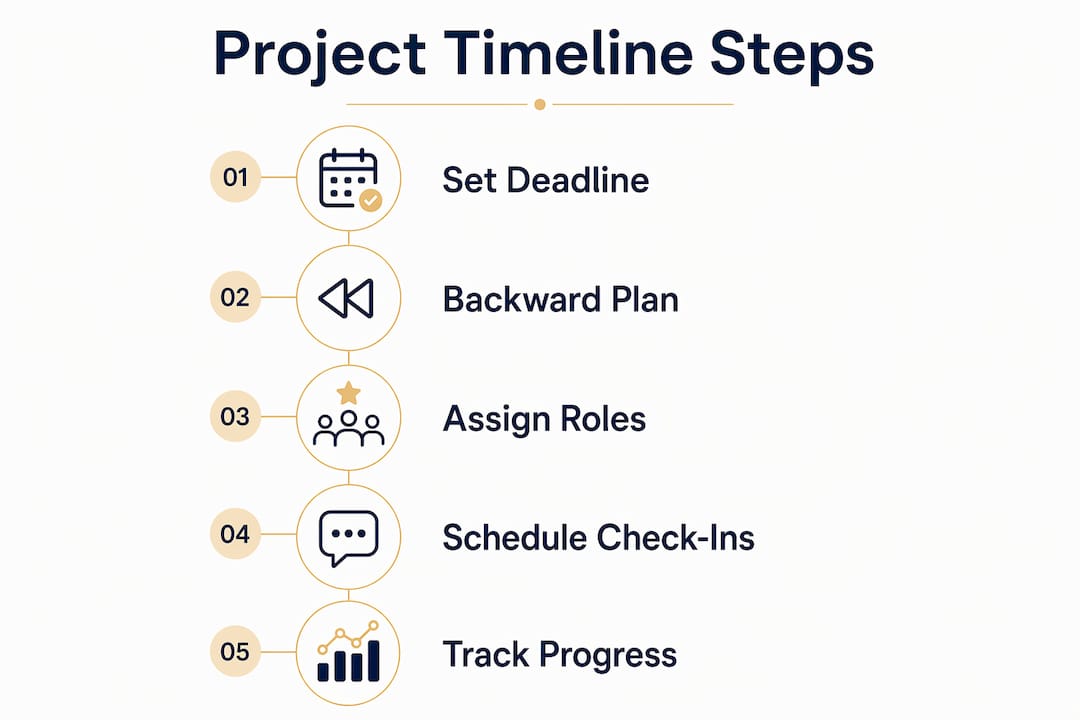
The most reliable way to manage a group project timeline is to work backward from the final due date and break the project into defined stages. IE University recommends sharing this timeline visibly so every member understands what is due, when, and in what order. This single habit eliminates the vague sense of “we have plenty of time” that causes late-stage pile-ups.
Follow these steps to build your timeline:
-
Write the final due date at the top. This is your anchor. Every other date flows backward from it.
-
Identify the major stages. For most academic projects, these are: research, outlining, drafting, peer review, and final revisions.
-
Assign a completion date to each stage. Be realistic. Drafting a 3,000-word report takes longer than most students estimate.
-
Map dependencies. Dependency-based milestones prevent invisible stalls. If the outline must be finished before drafting begins, that sequence needs to be visible to everyone.
-
Add buffer days. Build two to three buffer days before each major milestone, not just the final submission. This absorbs the inevitable delays caused by clashing exam schedules or slow feedback.
Pro Tip: Place your shared timeline in a location everyone checks daily, such as a pinned Notion page or a Google Calendar shared with the whole group. A timeline nobody looks at is no better than no timeline at all.
The table below compares two common approaches to timeline construction:
| Approach | How it works | Risk level |
|---|---|---|
| Deadline-first (backward planning) | Start from the due date, assign stage dates in reverse | Low. Deadlines are always visible and realistic. |
| Task-first (forward planning) | List tasks and estimate durations from today | High. Teams often underestimate total time and run out of it. |
Backward planning consistently produces more realistic schedules because it forces you to confront the fixed endpoint before you start estimating.
What roles and tools keep everyone accountable?
Clear role definitions and shared digital tools are the two mechanisms that make ownership visible and communication predictable. Setting up a group charter in week one, which documents contribution norms and communication expectations, reduces the ambiguity that causes conflict later.

The most practical structure for role clarity is the RACI matrix. RACI stands for Responsible, Accountable, Consulted, and Informed. Each task in your project gets assigned to one of these categories for each team member. The result is a single document that answers “who does what” without requiring a group discussion every time a decision needs to be made.
Beyond roles, your group needs one shared workspace and one shared calendar. Splitting files across email, WhatsApp, and personal drives is the fastest way to lose work and miss updates. A shared online calendar consolidates all deadlines and responsibilities into a single visible hub, which eliminates the “I didn’t know that was due today” excuse entirely.
Here is what your week-one setup should include:
-
A group charter documenting how decisions are made, how absences are handled, and what counts as a missed commitment
-
A RACI matrix covering every major task in the project
-
A single shared workspace
-
A calendar with all milestones, submission dates, and meeting times entered on day one
-
A communication channel with an agreed response time (24 hours is a reasonable standard)
Pro Tip: Document missed commitments factually and without blame in your shared workspace. If a member misses a deadline, log the date, the task, and the agreed new date. This creates a fair record if disputes arise later and keeps the group focused on solutions rather than grievances.
How do you run check-ins that actually move the project forward?
Recurring check-ins are the mechanism that prevents schedule drift. Without them, a timeline is a static document that becomes less accurate every day. Atlassian emphasises that active progress monitoring and schedule updates are what keep a project on track. A timeline that is not updated regularly is just a guess.
The most effective format is a weekly 30-minute sync with a fixed agenda. Keep the agenda to three questions: what changed since last week, what is blocking progress, and what are the next steps before the following meeting. This structure prevents the meeting from becoming a general discussion and keeps every minute productive.
Standing meetings with strict 10-15 minute time boxes work particularly well for mid-week check-ins between longer weekly syncs. Any topic that cannot be resolved in the time box gets “parked” with an assigned owner and a follow-up date. This prevents one person’s problem from consuming the whole group’s time.
“A check-in that ends without an updated timeline and assigned next steps is just a conversation. Make every meeting produce a concrete output.”
Here is a repeatable check-in format that works for most student groups:
-
Review the timeline (5 minutes). Compare planned progress against actual progress. Mark completed tasks and flag anything behind schedule.
-
Surface blockers (5 minutes). Each member names one thing preventing them from completing their next task. The group assigns a resolution owner immediately.
-
Confirm next steps (5 minutes). Every member leaves with one specific task, a completion date, and a clear deliverable. No vague commitments.
-
Update the shared workspace. Before the meeting ends, update the Notion board or project tracker to reflect the current state of the project.
Pro Tip: End every check-in with output-centred commitments: updated timeline, next owner assigned, and a defined next-step date. This transforms check-ins from status updates into actual plan management.
Practical tactics for scheduling work sessions and deliverables
Translating a milestone timeline into concrete, trackable work sessions is where most student groups lose momentum. A milestone says “draft due Friday.” A work session says “Ahmed writes the introduction (600 words, 60 minutes) by Wednesday at noon, and Priya completes the literature review (800 words, 90 minutes) by Thursday at 5pm.” The second version is what actually gets done.
Work sessions should have specific deliverables and time estimates attached to them. Writing clear goals in calendar event notes reduces missed expectations because every member knows exactly what they are responsible for producing, not just that they are “working on the project.”
Practical tactics for scheduling work sessions:
-
Create signup slots for each task with an estimated time frame. Peer review typically takes 30 to 45 minutes. Drafting a section takes 60 to 90 minutes. Calibrate your estimates to the actual task, not a round number.
-
Write the expected output in the calendar event description. “Review Ahmed’s introduction and leave comments in by 5pm” is a deliverable. “Review draft” is not.
-
Balance workloads across the group. Use your RACI matrix to check that no single member carries more than 40% of the total task load. Uneven workloads cause resentment and late dropouts.
Pro Tip: Link each deliverable directly to its calendar event. When Priya’s literature review is due Thursday at 5pm, the calendar event should contain a direct link to the shared doc. This removes the friction of searching for the right file at the last minute.
| Work session type | Recommended time estimate | Expected deliverable |
|---|---|---|
| Peer review | 30 to 45 minutes | Written comments in shared document |
| Section drafting | 60 to 90 minutes | Completed draft section with word count met |
| Research and note-taking | 45 to 60 minutes | Annotated source list or summary notes |
| Final revision and formatting | 60 to 90 minutes | Polished, submission-ready document |
Key takeaways
Keeping a group project on schedule requires a backward-planned timeline, explicit role ownership via a RACI matrix, and output-focused check-ins that update the schedule in real time.
| Point | Details |
|---|---|
| Build backward from the deadline | Work backward from the due date to assign realistic stage completion dates and buffer days. |
| Set up structure in week one | A group charter, RACI matrix, shared workspace, and shared calendar prevent most scheduling failures. |
| Run output-focused check-ins | Every meeting must end with an updated timeline, assigned next steps, and defined completion dates. |
| Attach deliverables to work sessions | Specify the expected output and time estimate for every work session, not just the milestone. |
| Keep the timeline live | Update your shared timeline after every check-in so it reflects actual progress, not original assumptions. |
How Culleva helps you stay on top of group work
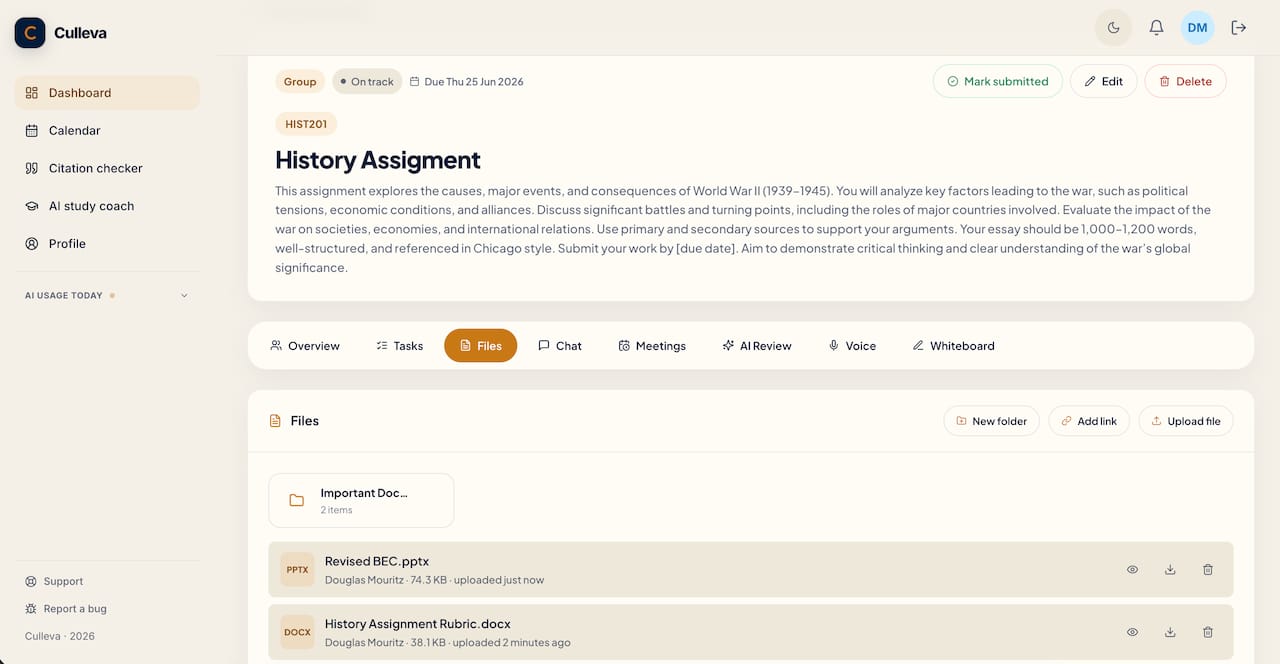
If you want one place to manage everything described in this article, Culleva is built for exactly that. Culleva’s group-work hub combines voice and text chat, screen sharing, shared scheduling with calendar sync, assignment-linked file storage, and a collaborative whiteboard into a single workspace. You do not need to stitch together Google Calendar, Notion, and a separate chat tool. Culleva holds all of it in one place, purpose-built for university students managing academic group projects. It also tracks individual assignments and deadlines alongside your group work, so nothing falls through the gaps when your schedule gets busy.
FAQ
How do you keep a group project on schedule?
Work backward from the final due date to create a milestone schedule, assign clear roles using a RACI matrix, and run weekly check-ins that update the timeline based on actual progress. A shared calendar that consolidates all deadlines and responsibilities is the most practical tool for maintaining visibility across the group.
What is a RACI matrix and why does it matter for group projects?
A RACI matrix assigns each task a status of Responsible, Accountable, Consulted, or Informed for every team member. It eliminates ambiguity about who owns each task and prevents the duplication or neglect of work that causes schedule failures.
How often should a student group meet to stay on track?
A weekly 30-minute sync is the recommended minimum for most academic group projects. Mid-week standing meetings of 10 to 15 minutes work well for resolving blockers between longer sessions without consuming excessive time.
What should a group project check-in include?
Every check-in should cover three things: a review of planned versus actual progress on the timeline, identification of current blockers with assigned resolution owners, and confirmed next steps with specific deliverables and due dates for each member.
Why do group projects fall behind schedule?
Group project failures most commonly stem from missing structure rather than lack of effort. Undefined roles, no shared timeline, and absent check-ins allow small delays to compound undetected until the deadline is imminent.
Recommended
Stay on top of every assignment
Culleva brings your assignments, group work, calendar, and an AI study coach into one place. Free to start.