How to divide group tasks fairly at uni

TL;DR:
- Fair task distribution involves assigning work based on effort, complexity, and skills rather than just task count. A weighted approach with clear roles and protocols ensures fairness and reduces last-minute chaos in group projects. Regular check-ins and explicit recognition of invisible labour help maintain balance and team morale throughout the process.
Fair task distribution means assigning work based on effort, complexity, and individual skills so no one carries the whole project alone. Splitting tasks equally by count sounds fair, but it rarely is. A 500-word literature review and a 2,000-word analysis section are not the same job. This guide shows you how to divide group tasks fairly using weighted allocation, clear role assignments, and a few practical agreements your group can set up in week one. Get this right and you’ll spend less time chasing teammates and more time on the actual work.
How do you divide group tasks fairly?
Fair task distribution is not the same as equal task distribution. Weighted distribution works better than equal task counts because complexity, time, and skill requirements vary widely across a project. Giving everyone two tasks each ignores the fact that one task might take three hours and another might take ten.

The idea is simple. A weighted system, where tasks are assigned by effort and availability rather than split evenly, tends to feel fairer to everyone. The principle applies directly to your PSYC101 or MGMT2001 group assignment.
There is also the issue of cognitive labour. A lot of the work in a group is invisible: chasing replies, consolidating files, formatting references, and keeping track of what is due. It is easy for one person to carry all of that while everyone assumes the split is fair. That labour counts, and it needs to be assigned, not assumed.
Key principles for equitable workload sharing:
-
Weight tasks by difficulty and time, not just by count
-
Assign cognitive labour explicitly, including coordination, editing, and deadline tracking
-
Acknowledge invisible tasks like file management, formatting, and chasing contributors
-
Match tasks to strengths where possible, but avoid locking one person into all the hard work
Pro Tip: Before your first group meeting, each member estimates how long their assigned task will take. If estimates vary wildly, that’s a signal the split needs adjusting.
How to plan fair task allocation from the start
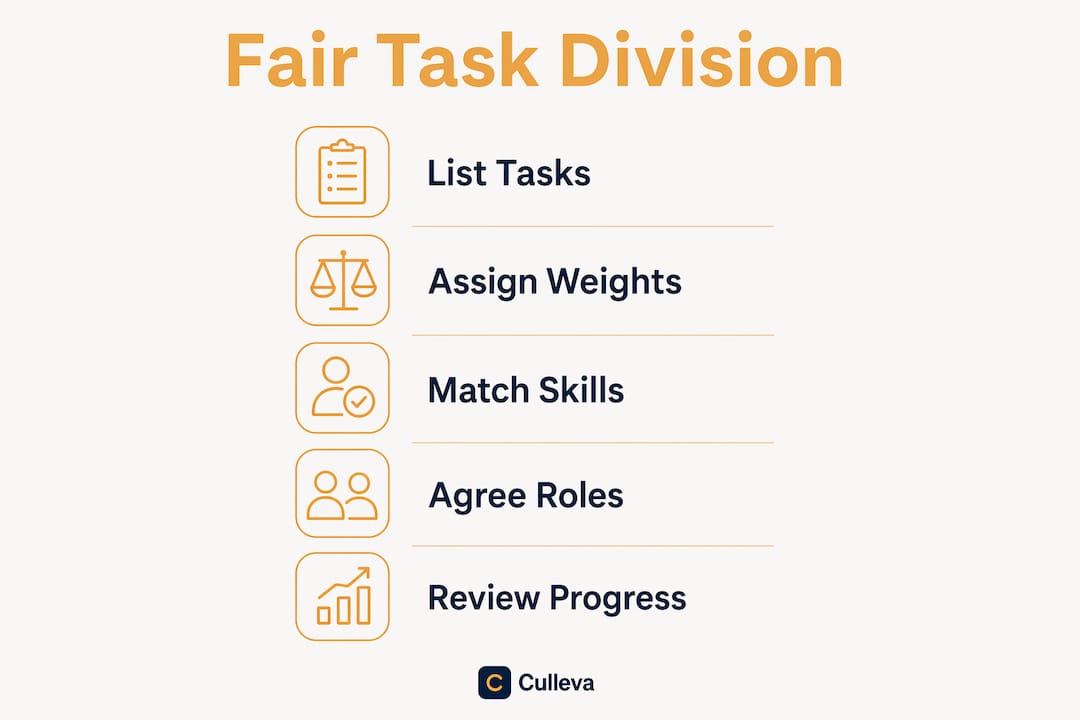
The best time to sort out equitable workload sharing is right after your group forms, not the week before submission. A good approach is to take three steps as soon as the project starts: break the project into subtasks, agree on deadlines, and formalise how you’ll communicate and share files.
Here is a practical process your group can follow in your first tute or meeting:
-
List every deliverable. Write out every section, task, and supporting job. Include formatting, referencing, and proofreading as separate items.
-
Estimate time for each task. Be honest. A literature review in a new topic area takes longer than summarising lecture content you already know.
-
Assign an Integrator role. This person consolidates everyone’s work, checks for consistency, and manages the final submission. Coordination work like scheduling, file consolidation, and follow-ups is invisible but critical. It should be a formally assigned, valued role.
-
Set internal deadlines. Aim for drafts two days before the real deadline. This gives the Integrator time to actually integrate.
-
Agree on a communication channel. One channel, whether that’s a group chat, shared doc, or a platform with built-in messaging. Scattered communication creates scattered accountability.
| Task Type | Example | Estimated Effort |
|---|---|---|
| Content creation | Writing a 600-word section | High |
| Research and sourcing | Finding 8 peer-reviewed articles | Medium to high |
| Coordination | Chasing drafts, consolidating files | Medium |
| Editing and formatting | Proofreading, APA referencing | Medium |
| Presentation prep | Building slides, rehearsing | Medium |
Pro Tip: Use a shared document or whiteboard to list every task with the assigned person’s name and due date. Visibility alone reduces the chance of someone quietly falling behind.
What strategies ensure fairness beyond equal task counts?
Splitting tasks evenly by number is the default. It’s also the method most likely to breed resentment by week three of a semester. No universal best method exists for fair allocation. Weighted and skill-based approaches produce better outcomes.
Strategies that actually work:
-
Use a point system. Assign each task a difficulty score from 1 to 5. Aim for each person to hold a similar total score, not a similar number of tasks.
-
Pair novices with experienced students. Pairing less-experienced students with more experienced ones improves learning and avoids the trap where top students monopolise the important work. It also stops one person from carrying all the difficult sections.
-
Rotate the coordination role. If your project runs across multiple weeks, rotate who manages scheduling and follow-ups. No one should hold that load for the entire project.
-
Pre-agree on what happens if someone misses a deadline. A fairness contract, with agreed protocols for non-delivery, prevents last-minute workload dumps and the resentment that follows.
| Allocation Method | Best For | Limitation |
|---|---|---|
| Equal task count | Simple, short projects | Ignores task complexity |
| Weighted point system | Complex, multi-part projects | Requires upfront effort to set up |
| Skill-based pairing | Mixed-experience groups | Can slow down faster students |
| Rotating coordination | Long-running projects | Needs clear handover process |
For a deeper look at how to structure your group from the start, the task allocation guide on the Culleva blog covers this in detail for uni students.
What pitfalls cause unfair task distribution?
The most common problem is the “hero” tendency. One reliable person picks up the slack when others fall behind. Overburdening the most engaged team members leads to burnout and damages team morale. Tracking assignments helps spot this imbalance before it becomes a crisis.
Other pitfalls to watch for:
-
Invisible labour accumulation. The person who sends all the reminder messages, books the Zoom calls, and reformats everyone’s references is doing real work. If it’s always the same person, that’s a problem.
-
Unclear task rationale. Perceptions of fairness improve when members understand the reasoning behind task division, even if the split is uneven. Explain why someone got the harder section. Silence breeds assumptions.
-
No check-in process. Groups that never formally review progress mid-project are the ones scrambling at 11pm the night before submission.
The fix for most group work problems is the same: talk about it earlier than feels comfortable. Renegotiating workload in week two is far easier than in week six.
Schedule a short check-in at the halfway point of your project. Ten minutes on Canvas or Moodle to confirm everyone is on track prevents the last-minute workload dump that tanks both your grade and your relationships with your groupmates. If you want to keep your project on schedule from start to finish, this group project scheduling guide is worth a read.
Key takeaways
Dividing group tasks fairly requires weighted allocation, explicit role assignment, and agreed protocols, not just splitting tasks equally by count.
| Point | Details |
|---|---|
| Weight tasks by complexity | Assign difficulty scores so total effort is balanced, not just task numbers. |
| Assign the Integrator role | Formally give one person the coordination job so invisible labour is recognised. |
| Pre-agree on missed deadlines | A fairness contract prevents last-minute workload dumps and resentment. |
| Explain your allocation logic | Teams accept uneven splits when the rationale is clear and communicated early. |
| Check in at the halfway point | A short mid-project review catches imbalances before they become crises. |
Keep your group project organised with Culleva
Group projects are hard enough without chasing people across five different apps. Culleva’s group-work hub puts voice and text chat, a shared group calendar, shared file storage, and a collaborative whiteboard all in one place. You can assign tasks, track who’s done what, and keep everyone accountable without the chaos of scattered group chats.
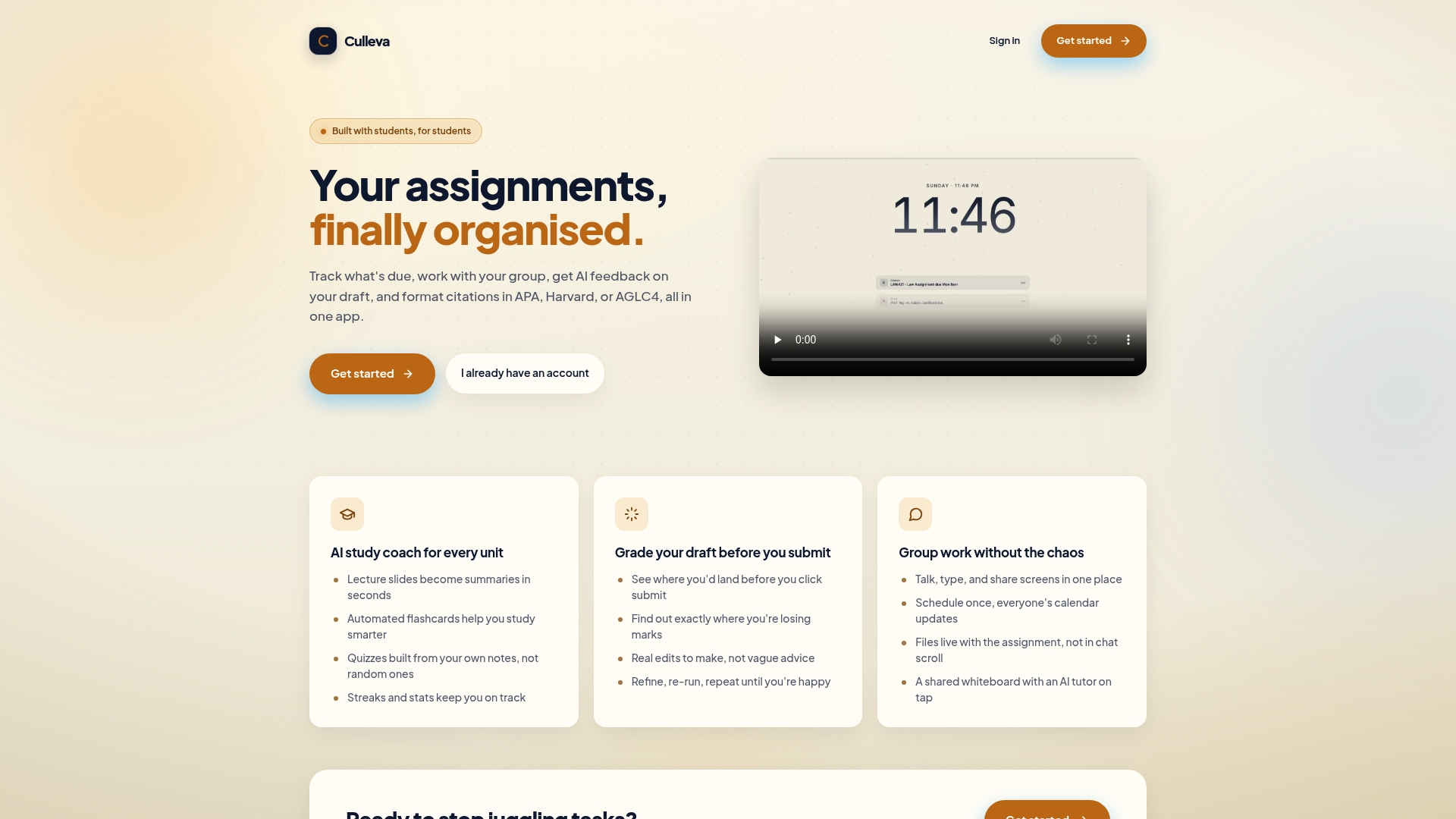
Culleva also handles APA, Harvard, and AGLC4 citation formatting, so your Integrator isn’t stuck reformatting references at midnight. If you want your next group assignment to actually run smoothly, get started with Culleva and keep your whole group finally organised.
FAQ
What does it mean to divide group tasks fairly?
Fair task division means assigning work based on effort, complexity, and individual skills, not just splitting tasks equally by count. A weighted approach ensures no one is overloaded while others coast.
How do you assign tasks evenly in a group project?
Use a point system where each task gets a difficulty score, then aim for each person to hold a similar total score. Pair this with clearly assigned roles, including a dedicated Integrator for coordination work.
What is cognitive labour in group work?
Cognitive labour covers the planning, organising, and follow-up work that keeps a project moving. Examples include chasing late contributors, consolidating files, and managing deadlines. It should be formally assigned, not left to whoever notices it needs doing.
How do you handle a group member who isn’t pulling their weight?
Pre-agree on a fairness contract at the start of the project that includes protocols for missed deadlines. Raise the issue early, at a scheduled check-in rather than the night before submission, and renegotiate workload directly and without blame.
Why do equal task splits often feel unfair?
Equal splits ignore differences in task complexity, time requirements, and individual skill levels. Weighted distribution accounts for these differences and produces a more genuinely equitable outcome.
Recommended
Stay on top of every assignment
Culleva brings your assignments, group work, calendar, and an AI study coach into one place. Free to start.