How pre-submission feedback works for uni students

TL;DR:
- Pre-submission feedback is an expert review designed to identify weaknesses in your academic work before submission.
- It helps improve argument strength, methodology, and structure to prevent last-minute errors.
Pre-submission feedback is a structured expert review of your academic work before you officially submit it. The goal is simple: identify weaknesses in your argument, methodology, or structure early enough to fix them. Understanding how pre-submission feedback works can be the difference between a confident submission and a last-minute panic rewrite. It applies to research essays, lab reports, theses, and any high-stakes assessment where the marking criteria are complex. Culleva’s draft-grading tool is one way to get this kind of targeted critique before you hit submit.
How does the pre-submission feedback process work?
Pre-submission feedback follows a clear sequence. Knowing the steps helps you use the process well rather than just hoping for the best.
-
Submit your draft for review. You share your work with a reviewer before the official due date. This could be your unit coordinator, a writing centre adviser, or an AI-assisted tool like Culleva. The earlier you do this, the more time you have to act on what comes back.
-
The reviewer assesses your core argument. A good reviewer checks whether your claims are supported by your evidence. Expert reviewers look for gaps where your discussion understates its limits or where your methodology does not support your conclusions. This is the most valuable part of the process.
-
Feedback is prioritised by impact. Not all feedback is equal. Effective pre-submission feedback identifies what to fix first under time constraints, targeting the issues most likely to cost you marks. A weak method section in PSYC101 or an unsupported claim in a LAWS3000 essay will hurt your grade far more than a clunky sentence.
-
You receive a detailed report or annotated comments. The reviewer delivers specific, revision-focused notes. These are not vague encouragements. They tell you exactly where your argument breaks down and what to do about it.
-
You revise and resubmit internally. You work through the feedback, make changes, and ideally run the draft past the reviewer again before the final submission date.
Pro Tip: Book your pre-submission review at least one week before your due date. Two rounds of feedback with time to revise in between will improve your work far more than one rushed session the night before.
How is pre-submission feedback different from peer feedback and proofreading?

Students often mix these three things up. They serve very different purposes.
| Review type | Focus | Depth | Confidentiality |
|---|---|---|---|
| Pre-submission feedback | Argument, methodology, structure | Deep, strategic critique | Often protected by formal agreements |
| Peer feedback | General impressions, surface comments | Variable, often informal | No formal protection |
| Proofreading | Grammar, spelling, clarity | Surface level only | Varies |
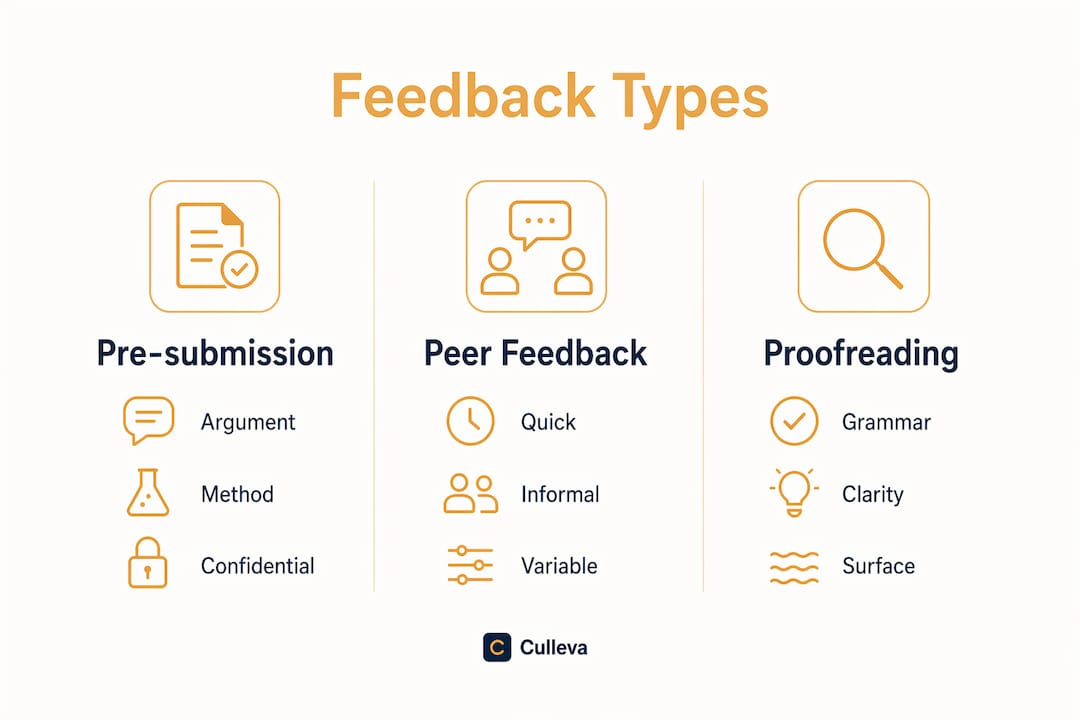
Pre-submission feedback is distinct from language editing. It targets the substance of your work, not the surface. A proofreader will fix your comma splices. A pre-submission reviewer will tell you your argument in paragraph four contradicts your thesis.
Peer feedback from a classmate in your tute group can be useful, but informal peer feedback may be biased and lacks the confidentiality safeguards of a formal review. Sharing an unpublished draft without any protection creates real risks, including plagiarism. Professional pre-submission services often use non-disclosure agreements to protect your work. That matters more than most students realise.
The practical takeaway: use proofreading for polish, peer feedback for a quick gut-check, and pre-submission review for anything where the argument or structure needs to hold up under scrutiny.
What should you prioritise when acting on pre-submission feedback?
Getting feedback is only half the job. Acting on it well is where students actually improve their grades.
Start with the highest-risk issues. These are the problems most likely to trigger a low mark or a request to resubmit. Common examples include:
- A method section that does not justify your conclusions
- An abstract that claims more than your evidence supports
- A structure that buries your main argument in paragraph six
- Missing citations in APA or Harvard format that leave key claims unsupported
- A discussion section that ignores the limitations your reviewer flagged
Once you have fixed those, move to the secondary issues. These are the suggestions that improve clarity or flow but would not, on their own, sink your grade.
Time management matters here. If you have five days before your HIST2200 essay is due and your reviewer has flagged ten issues, do not spend three days perfecting your introduction while your methodology section stays broken. Fix the big things first.
Pro Tip: When you get feedback back, read it once without touching your draft. Let it settle. Then go back and categorise each comment as either “must fix” or “nice to fix.” Work through the must-fix list before you touch anything else.
Knowing when to retarget is also worth considering. If your draft consistently fails to meet the assessment criteria despite multiple rounds of revision, the issue might be your approach to the question rather than the writing itself. A fresh read of your assignment brief at that point can reset your direction quickly.
Is pre-submission feedback worth it for Australian and New Zealand uni students?
For most students, yes. The benefits are concrete.
- It reduces the risk of submitting work with a structural flaw you cannot see yourself. Pre-submission reviews can reduce total revision time by catching problems early, before they compound.
- It improves your WAM over time. One stronger essay in semester one lifts your average in a way that is hard to recover from if you skip it.
- It builds your understanding of what markers actually want. Reading specific feedback on your own work teaches you faster than any generic study guide.
- It gives you confidence at submission. Knowing a second set of eyes has checked your argument means you submit without second-guessing every paragraph.
The downsides are real too. Pre-submission review takes time, and if your draft is not far enough along, the feedback will be too general to act on. Choosing the wrong reviewer, someone who does not understand your unit’s marking criteria, can also send you in the wrong direction.
Pre-submission enquiries may be less useful for a draft that already fits the assignment criteria tightly. If your essay is well-structured and your argument is solid, direct submission might get you more useful feedback from your marker than another round of pre-submission review.
The sweet spot is a draft that is complete but not polished. That is when targeted feedback does the most work.
Culleva and your pre-submission preparation
Culleva’s draft-grading tool is built for exactly this moment in your assignment cycle.
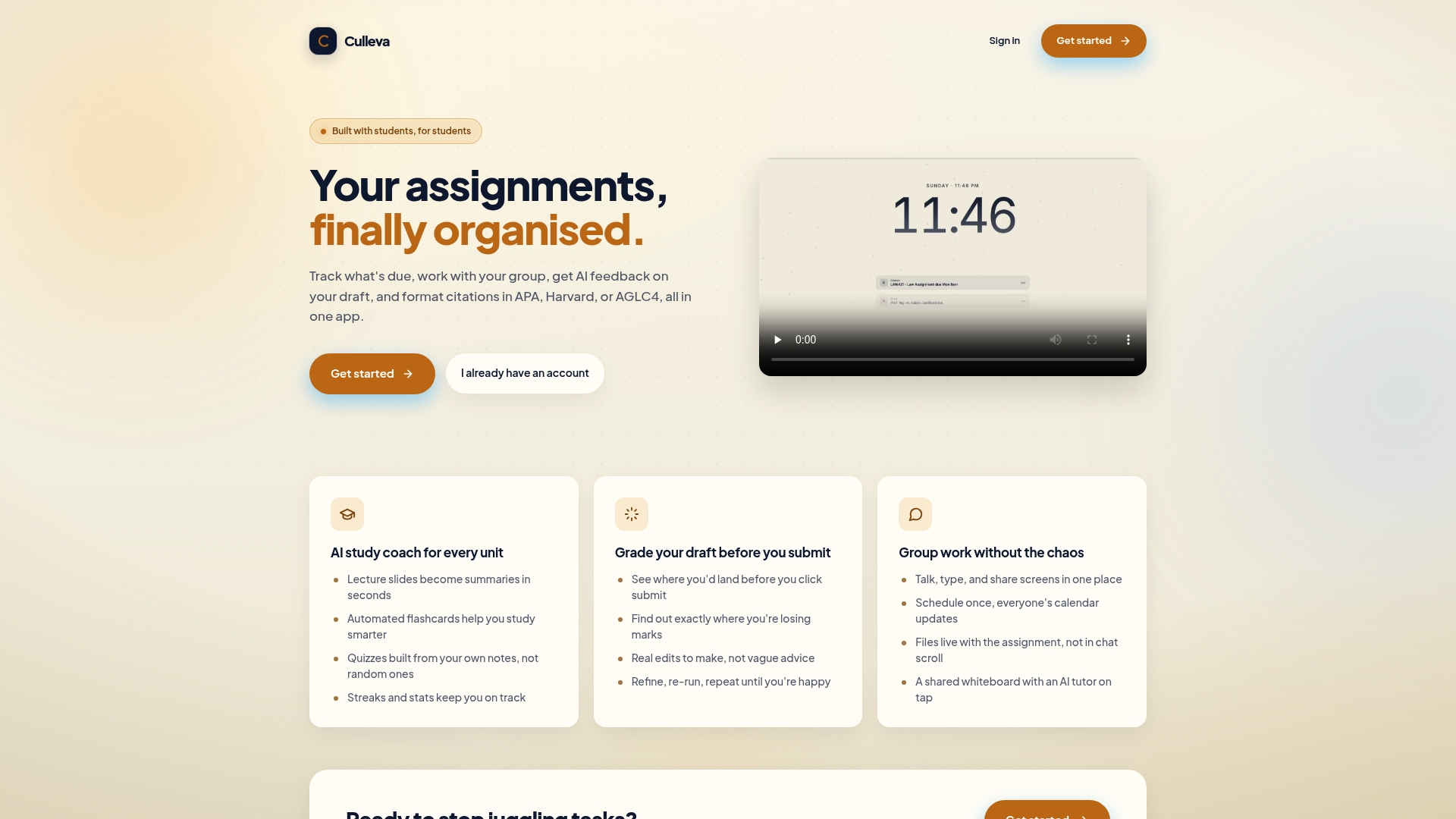
You upload your draft, and Culleva estimates your likely mark, pinpoints where you are losing points, and gives you concrete edits rather than vague comments. You can revise and re-run as many times as you need before your due date. It also handles APA, Harvard, and AGLC4 citation formatting, so your references are sorted before you submit. For a full walkthrough of what to check before you hit submit, the assignment submission checklist on the Culleva blog covers every step. Whether you are in week six of a heavy semester or pulling together a thesis chapter, Culleva keeps your preparation on track.
Key takeaways
Pre-submission feedback is the single most effective step you can take to improve your academic work before it is formally assessed.
| Point | Details |
|---|---|
| Start with a complete draft | Feedback works best on a full draft, not a half-finished outline. |
| Fix high-impact issues first | Target argument gaps and methodology flaws before polishing language. |
| Know what type of review you need | Pre-submission feedback addresses substance; proofreading addresses surface errors only. |
| Protect your unpublished work | Use formal review channels with confidentiality protections, not informal sharing. |
| Use Culleva to grade before you submit | Culleva’s draft-grading tool estimates your mark and flags where you are losing points. |
FAQ
What is pre-submission feedback?
Pre-submission feedback is an expert review of your academic work before official submission. It focuses on argument strength, methodology, and structure rather than grammar or spelling.
How early should I seek pre-submission feedback?
Aim to have your draft ready for review at least one week before your due date. This gives you enough time to act on the feedback and make meaningful revisions.
Is pre-submission feedback the same as proofreading?
No. Proofreading focuses on grammar and clarity, while pre-submission feedback critiques your argument, evidence, and structure at a deeper level.
Can I use peer feedback instead of a formal pre-submission review?
Peer feedback is useful for a quick check, but informal peer reviews can be biased and offer no confidentiality protection for your unpublished work.
How does Culleva support pre-submission feedback?
Culleva’s draft-grading tool estimates your likely mark, identifies where you are losing points, and suggests concrete edits so you can improve your work before you submit.
Recommended
Stay on top of every assignment
Culleva brings your assignments, group work, calendar, and an AI study coach into one place. Free to start.