Common group assignment conflict causes: 2026 guide

TL;DR:
- Group conflicts in assignments mostly arise from unclear roles, mismatched effort levels, fragmented communication, free-riding, and working style clashes. Addressing these issues early with concrete task definitions, shared communication channels, and early expectation discussions can prevent most disputes. Proper documentation and understanding conflict types help manage persistent disagreements effectively.
Group assignment conflicts are defined by five recurring causes: unclear task ownership, mismatched commitment levels, fragmented communication, free-riding, and clashing working styles. These are not random personality problems. Most conflicts stem from coordination failures rather than bad intentions, which means you can actually do something about them. Understanding the common group assignment conflict causes before Week 3 hits puts you ahead of most students in your unit.
1. Unclear task ownership triggers most group disputes
Vague task division is the single most reliable predictor of group conflict. When your group says “you do the research, I’ll write it up,” everyone walks away with a different mental picture of what that actually means. Ambiguous assignments lead to mismatched expectations, stalled progress, and real resentment by Week 5.
The fix is converting every task into a concrete deliverable with a clear “definition of done.” Instead of “research the topic,” write “find five peer-reviewed sources from the last ten years and summarise each in 100 words by friday of Week 4.” That sentence leaves no room for interpretation.
A RACI matrix (Responsible, Accountable, Consulted, Informed) is a practical tool for dividing group tasks fairly at the start of a project. It takes fifteen minutes to set up and saves hours of arguments later.
- List every deliverable, not just broad roles
- Assign one owner per task, not “everyone”
- Set a due date for each item, not just the final submission
- Agree on what “done” looks like before anyone starts
Pro Tip: Write your task list in a shared doc during your first group meeting. Screenshot it and pin it to your group chat so no one can claim they didn’t know what they were responsible for.
2. Mismatched commitment levels create friction fast
Differences in effort expectations are one of the most common group project disagreement reasons at Australian and New Zealand unis. One student is gunning for a High Distinction in COMM101, another just needs a Pass to keep their scholarship, and a third is working 30 hours a week at a café. None of them are wrong. But without an honest conversation, that gap becomes a source of real resentment.
The best time to surface these differences is your very first meeting, before anyone has done any work. A quick round of “what grade are we aiming for and how much time can each of us realistically commit?” sounds awkward but prevents weeks of passive aggression.
- Agree on a minimum acceptable standard for the group output early
- Be honest about your own constraints, not just your ambitions
- Set a shared target grade and work backwards to divide effort fairly
- Use peer-assessment processes (many units on Moodle or Canvas include these) to hold everyone accountable
- Revisit commitments at the midpoint of the project, not just at the start
Conflict in student groups is often not about bad behaviour. It is about students with different ambitions being thrown together by the uni without a structure to manage those differences.
3. Fragmented communication systems make conflicts worse

Scattered channels are a major cause of group work disputes. Your group uses WhatsApp for quick messages, email for “official” stuff, Canvas for submission, and someone always posts the important decision in the wrong place. Fragmented communication means decisions get missed, deadlines get lost, and accountability disappears.
The practical solution is one shared space for everything: decisions, files, deadlines, and updates. When information lives in five places, someone always misses something. When it lives in one place, there are no excuses.
| Channel | Common problem | Better use |
|---|---|---|
| Decisions get buried in chat | Quick check-ins only | |
| Slow, easy to miss | Formal communications | |
| Canvas/Moodle | Read-only for students | Submission and announcements |
| Shared workspace | None, if used consistently | All decisions, files, deadlines |
Good group project communication practice means logging every decision with a date and the name of who agreed to it. That record protects you if a dispute goes to your tutor.
Pro Tip: After every group meeting, send a one-paragraph summary of what was decided and who owns what. Paste it into your shared doc. This takes three minutes and removes “I didn’t know” from the conversation entirely.
4. Free-riding causes resentment and drags down results
Free-riding is defined as one or more group members contributing significantly less work while sharing the same grade. Unequal participation is one of the most common teamwork conflict triggers in university group assignments, and it is also one of the hardest to address once it is entrenched.
Free-riding happens for different reasons. Sometimes a student is overwhelmed by other units. Sometimes they genuinely do not understand what is expected. Sometimes they are disengaged and hoping no one notices. The cause matters because it changes how you respond.
- Document everything from Week 1: meeting attendance, who submitted what, and when
- Address it directly and early, not in Week 11 when the deadline is two days away
- Frame the conversation around the task, not the person (“the research section needs to be done by Friday” rather than “you never do anything”)
- If direct conversation does not work, involve your tutor sooner rather than later
- Check whether your unit uses a contribution tracking or peer-assessment tool, as many Canvas and Moodle units do
Clear documentation of attendance and missed deadlines often improves accountability on its own. People contribute more when they know a record exists.
5. Interpersonal clashes and working style differences
Personality conflicts are a real cause of group work disputes, but they are often misdiagnosed. Harvard’s Program on Negotiation identifies three distinct conflict types: task conflict (disagreements about how to do the work), relationship conflict (interpersonal friction), and value conflict (deep differences in beliefs or priorities). Treating a relationship conflict as a task dispute almost always makes it worse.
Working style differences are the most common version of this. One person wants a detailed plan by Week 2. Another works best under pressure and produces their best writing the night before. Neither approach is objectively wrong, but they create real friction when both people are on the same team.
Communication and working style differences affect how students perceive each other’s professionalism and responsiveness. An early starter who sends a message at 9am and gets no reply until 10pm reads that as disengagement, even if the other person was in a lecture.
- Identify which type of conflict you are dealing with before you try to fix it
- Use written communication when face-to-face conversations get heated
- Focus on the work output, not the person’s habits or personality
- Agree on response time expectations at the start (“we reply to messages within 24 hours”)
- If personalities genuinely clash, minimise direct contact and communicate through the shared workspace
Early intervention reduces group friction far more effectively than trying to fix things in the final week. Once a relationship conflict is entrenched, options narrow quickly.
Key takeaways
The most preventable group assignment conflicts come from unclear roles and fragmented communication, both of which you can fix in your first group meeting.
| Point | Details |
|---|---|
| Define tasks concretely | Convert every role into a specific deliverable with a due date and a clear definition of done. |
| Surface commitment gaps early | Agree on a target grade and realistic time commitments in your first meeting, not after conflict starts. |
| Use one communication channel | Log all decisions, files, and deadlines in a single shared space to prevent missed information. |
| Document contributions | Keep records of attendance and task completion from Week 1 to support accountability and tutor escalation. |
| Name the conflict type | Identify whether friction is task, relationship, or value-based before attempting to resolve it. |
Culleva keeps group work from falling apart
Group assignments go sideways when tasks are vague, communication is scattered, and no one knows who did what. Culleva’s group-work hub pulls everything into one place: voice and text chat, screen sharing, shared scheduling with calendar sync, assignment-linked file storage, and a collaborative whiteboard with an AI tutor on demand.
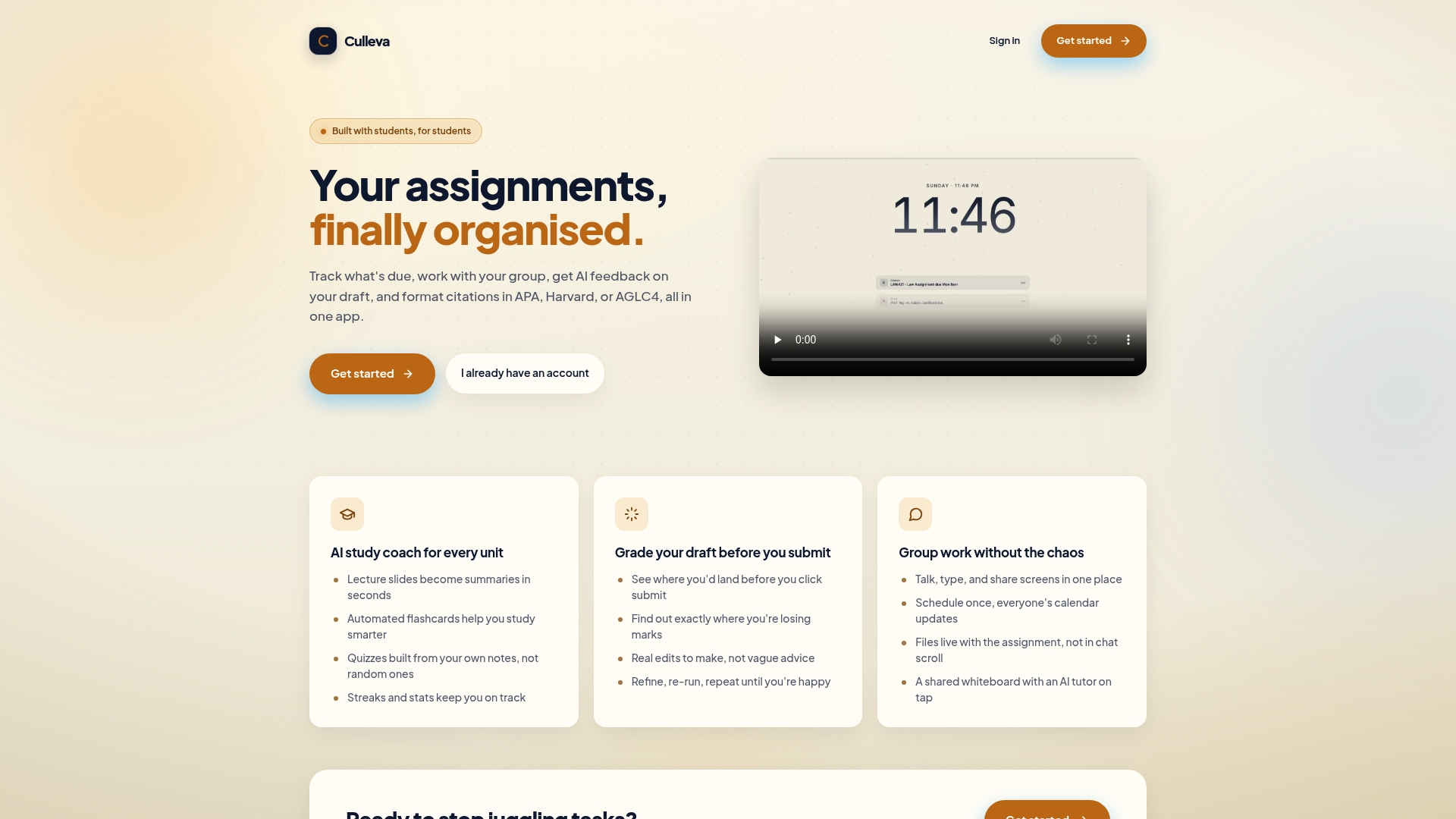
You can log decisions, track who owns each task, and keep your whole group on the same page without juggling WhatsApp, email, and Canvas at the same time. Culleva also handles APA, Harvard, and AGLC4 citation formatting, so your references are sorted before submission. If your group project is already feeling chaotic, Culleva’s group-work tools are worth a look.
FAQ
What are the most common causes of group assignment conflict?
The most common causes are unclear task ownership, mismatched commitment levels, fragmented communication, free-riding, and clashing working styles. Most of these stem from coordination problems rather than personality issues.
How do you handle a free rider in a group assignment?
Document contributions from Week 1, address the issue directly and early, and involve your tutor if the situation does not improve. Many units on Canvas and Moodle include peer-assessment tools that make contributions visible.
What is the difference between task conflict and relationship conflict?
Task conflict involves disagreements about how work should be done. Relationship conflict involves interpersonal friction between group members. Treating one as the other tends to make the situation worse.
When should you escalate a group conflict to your tutor?
Escalate when direct conversation has not worked and the conflict is affecting the quality of the group’s output or your own wellbeing. Bring documentation of missed deadlines and decisions when you do.
How does communication breakdown cause group project issues?
Scattered channels like WhatsApp, email, and Canvas fragment information so that decisions get missed and accountability disappears. A single shared workspace with logged decisions prevents most of these problems.
Recommended
Stay on top of every assignment
Culleva brings your assignments, group work, calendar, and an AI study coach into one place. Free to start.